
1. Introduction: The Global AI Race is ON!
Hey there, tech enthusiasts! Ever feel like AI is popping up everywhere, like an uninvited guest who’s slowly taking over the house? You’re not wrong – it’s reshaping our world at lightning speed, subtly altering the very fabric of our existence.
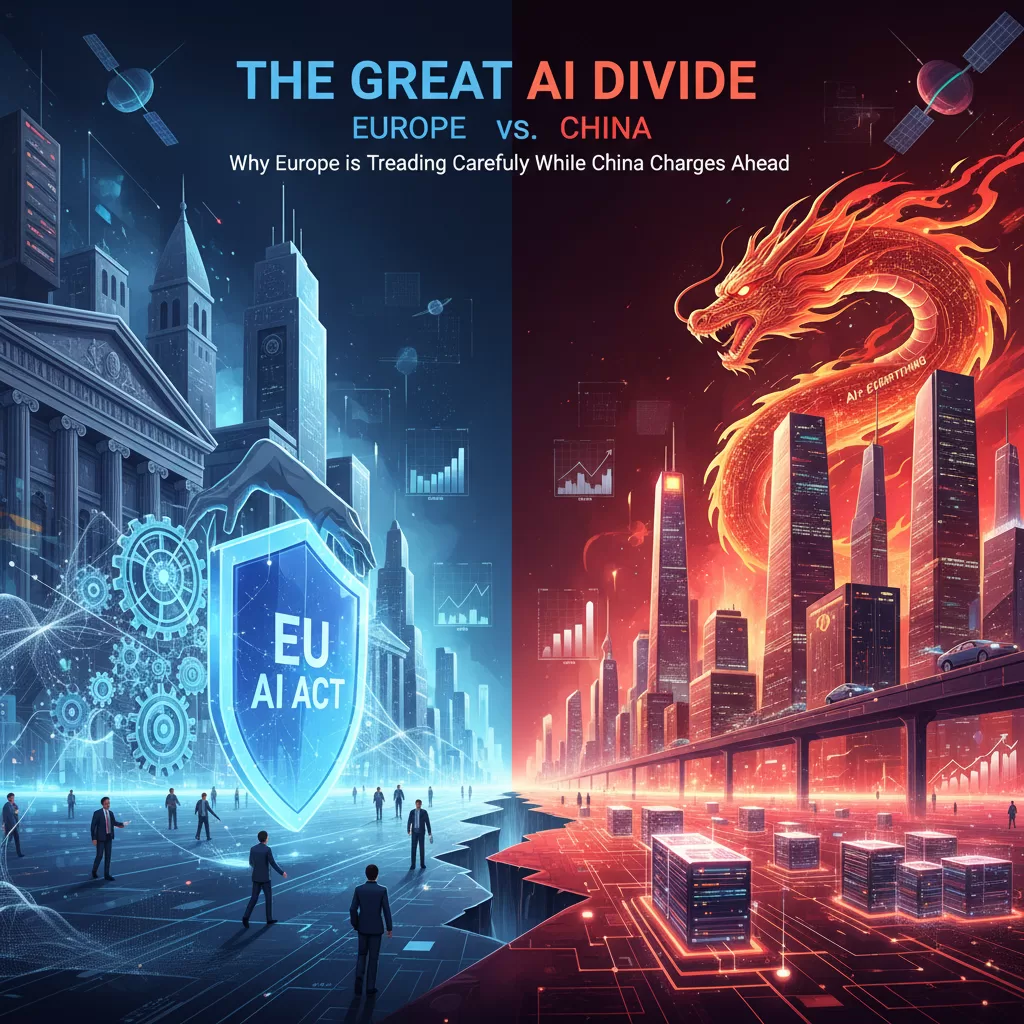
But who’s winning this silent revolution? Today, we’re peering into the contrasting strategies of two major players in the AI arena: Europe and China. It’s a bit like watching a chess match where one side meticulously plans each move while the other throws pieces across the board with audacious abandon.
The Big Scoop: Recent murmurs from the tech elite, including those at Google, suggest a troubling disparity: Europe appears to be lagging in the AI adoption race compared to the relentless charge of China. And the alleged culprit? Regulations. One might muse, are these regulations a necessary safeguard or an anchor holding back potential innovation?
What we’ll unwrap today: We’ll dissect this divergence, exploring the historical currents that have shaped each region’s trajectory, the controversies swirling like a dust devil in the desert, and the speculative futures awaiting us in this high-stakes tech showdown.
2. The Scoreboard: Europe’s Lag and China’s Sprint
Numbers Game: Let’s anchor ourselves in the cold, hard data.
Imagine this: as of 2025, a staggering 83% of Chinese companies have enthusiastically embraced generative AI, integrating it into their operations like a vital organ. Europe? A comparatively meager 14%. It’s a stark contrast, a chasm in adoption rates that begs further examination.
Investment patterns paint a similar picture of divergence. In 2023, Europe collectively invested $8 billion in the pursuit of AI advancements. China, with its ambitious gaze fixed on technological supremacy, channeled $15 billion. The United States, not to be outdone, poured a staggering $68 billion into the field. The gap, my friends, is not merely widening; it’s expanding at an exponential rate.
Two Paths Diverged:
- Europe’s Motto: “Human-centric, ethical, and cautious.” One might perceive this as a noble pursuit, a commitment to safety and ethical considerations above all else. But does this cautious approach risk relegating innovation to a secondary concern?
- China’s Playbook: “State-driven, rapid development, widespread integration.” It’s a strategy marked by unwavering ambition, a willingness to accelerate forward with little regard for potential pitfalls. Is it a reckless gamble or a calculated risk aimed at securing global dominance?
3. Once Upon an AI Time: A Quick History Lesson
Europe’s Measured March to Regulation:
- The Seeds: The journey began with a “White Paper” in early 2020 – a prolonged meditation on the ethical and societal implications of AI’s inevitable rise.
- The Birth of the AI Act: Following extensive debate and intricate drafting, the landmark EU AI Act was officially proposed in April 2021 and finally adopted in May 2024. It was a legislative marathon, a testament to the complexities of balancing innovation with ethical considerations.
- The GDPR Ghost: Let’s not forget Europe’s original guardian of data privacy, GDPR, which had already cast a long shadow over data-hungry AI systems long before the AI Act even entered the discussion.
- Phased Rollout: This isn’t an overnight transformation! Bans on “unacceptable risks” took effect in Feb 2025, regulations for General-Purpose AI (GPAI) in Aug 2025, and the majority of “high-risk” AI systems will be subjected to stringent scrutiny by Aug 2026. The gradual implementation suggests a desire to mitigate disruption, but does it also risk prolonging the period of uncertainty and hindering progress?
China’s Grand Design for Dominance:
- Blueprints for Brilliance: China’s AI ambitions took concrete form with the unveiling of “Made in China 2025” (2015) and the “Next Generation AI Development Plan” (2017) – clear roadmaps designed to chart a course towards global AI supremacy.
- Ambitious Milestones: Become globally competitive by 2020, world-leading by 2025, and the undisputed global AI leader by 2030. These aren’t mere aspirations; they’re strategic objectives backed by unwavering resolve.
- Agile Regulations: While the EU adopts a comprehensive approach, China’s regulations (such as those governing deepfakes or generative AI from 2021-2023) tend to be more targeted and often designed to encourage development while maintaining control. Is this a more pragmatic approach, allowing for innovation to flourish within defined boundaries?
4. The EU AI Act: Europe’s Ethical Super Shield… or a Lead Weight?
The Bright Side: Why Everyone Should Love It
- Trust is the New Gold: Companies that demonstrate compliance stand to gain a significant competitive advantage by offering “trustworthy AI” that upholds fundamental rights and privacy. It’s a premium label, a symbol of ethical integrity in an increasingly uncertain world.
- Setting the Global Standard: The EU hopes its Act will serve as the “Brussels Effect” for AI, influencing policy decisions worldwide, much like GDPR did for data privacy. Will the world embrace this model, or will other regions forge their own paths?
- Helping the Little Guys: Provisions exist for “regulatory sandboxes” and dedicated support desks to guide startups through the complex regulatory landscape. But will these measures be sufficient to level the playing field?
The Dark Side: Why Businesses Are Grumbling
- “Regulatory Spaghetti Bowl”: Critics argue that the Act is convoluted, a labyrinth of vague definitions, overlapping jurisdictions with existing laws like GDPR, and a dearth of clear, actionable guidelines.
- The Cost of Compliance: Compliance isn’t cheap. Estimates suggest that a single high-risk AI product could cost SMEs hundreds of thousands, while the overall cost to the EU economy could reach billions.
- Innovation Exodus? There’s a genuine concern that these stringent regulations could stifle creativity, drive talent away, and redirect investments to more lenient regions, such as the United States. Meta’s decision to withhold Llama 3 from the EU serves as a stark reminder of this risk.
- Are Rights Really Protected? Human rights groups express concerns about potential loopholes, particularly for law enforcement applications, and argue that the Act doesn’t go far enough in addressing subtle harms such as bias or “AI hallucinations.”
- Understaffed & Under Pressure: Doubts persist regarding the newly formed EU AI Office’s capacity to effectively enforce such a complex law within an aggressive timeframe.
5. China’s AI Machine: Unstoppable Force or Controlled Chaos?
- Government-Fueled Firepower: Beijing isn’t merely encouraging AI development; it’s actively funding it. We’re talking about billions in state investments, national funds, and regional hubs vying for AI dominance.
- “AI+ Everything”: China’s “AI+ Action” and “AI+ Initiative 2025” aim to seamlessly integrate AI into every aspect of the economy – from smart manufacturing to healthcare and education – with ambitious adoption targets (70% in key sectors by 2027!).
- Homegrown Heroes: A relentless pursuit of self-reliance, particularly in critical areas such as AI chips, with Chinese tech giants designing their own processors.
- Open-Source Power Play: China is actively promoting open-source AI models, such as DeepSeek, to accelerate development and make the technology widely accessible.
6. The Crystal Ball: What’s Next for the AI World?
Europe’s Next Steps:
- The AI Act isn’t going anywhere; expect further guidelines and delegated acts as it fully rolls out by 2027.
- The European AI Office will be diligently providing practical guidance and fostering innovation.
- New strategies like the “AI Continent Action Plan” (Apr 2025) and “Apply AI Strategy” (Oct 2025) are designed to bolster infrastructure, data availability, skills development, and industry adoption.
- The market is still projected for massive growth, potentially reaching hundreds of billions by 2030, despite the regulatory complexities.
China’s Continued Ascent:
- Expect even more aggressive investment and deeper integration of AI across all sectors.
- The relentless pursuit of self-sufficiency in AI technology will continue unabated.
- China will continue to promote its “Global AI Governance Initiative” to shape international AI rules, particularly in developing nations.
The Big Question on Everyone’s Mind: Can Europe’s ethical, human-centric approach cultivate a truly sustainable and trustworthy AI ecosystem, or will its regulatory caution leave it struggling to catch up with faster-moving rivals like China? The coming years will be a captivating spectacle.
7. Conclusion: A Fork in the AI Road
So, there you have it: two global powers, two radically different approaches to navigating the AI revolution.
Europe is prioritizing safety and ethics, aiming to build trust from the ground up. China is prioritizing speed, integration, and national leadership.
The stakes couldn’t be higher for economic competitiveness, global influence, and even the very essence of our societies.
Which path is superior? Only time will reveal the answer, but one thing remains certain: the future of AI will be fundamentally shaped by this intriguing East-West dynamic. Stay tuned, dear readers, for the unfolding chapters of this technological saga.