
I. Introduction: The Telecom Tangle and a Glimmer of Hope
Remember the fanfare? The breathless promises of instant movie downloads, seamless VR experiences, a world transformed by the sheer velocity of 5G? It arrived, we upgraded, and then…well, did much really change? This, I suspect, is the gnawing question keeping telecom executives awake at night.
The truth is, after a monumental investment in 5G infrastructure, the telecom industry finds itself in a bit of a pickle. Billions spent, but the returns? Let’s just say they haven’t exactly mirrored the initial hype. The core issue, as I see it, isn’t a technological failing, but a failure of imagination. Simply offering “faster” hasn’t proven compelling enough to pry open consumers’ wallets.
But fear not, fellow tech enthusiasts! A potential beacon of hope is emerging from an unexpected corner: China Mobile Shanghai, in collaboration with Huawei. Their approach to 5G-Advanced (5G-A) isn’t just about raw speed; it’s about crafting tailored experiences. Could this be the key to unlocking 5G’s true potential, a roadmap for the entire industry? Let’s delve in.
II. So, What Even Is 5G-Advanced? (A Quick Trip Down Memory Lane)
To understand the significance of China Mobile Shanghai’s approach, we need to briefly revisit the evolution of 5G. Think of the initial rollout of 5G (spanning roughly 2017-2021, encompassing 3GPP Releases 15-17) as the foundational layer. It delivered on its promise of increased bandwidth and reduced latency, a boon for mobile broadband. Yet, it felt…incomplete.
5G-Advanced (or 5.5G, as some call it), beginning with 3GPP Release 18 (finalized in June 2024), represents a significant leap forward. It’s not merely about incremental improvements in speed; it’s about injecting intelligence, adaptability, and a whole new level of sophistication into the network. We’re talking about seamless integration of Artificial Intelligence, enhanced support for Extended Reality (XR) applications, the enablement of Industrial IoT on a grand scale, and devices that sip power rather than guzzle it. It’s the crucial bridge between the 5G we have and the truly interconnected, intelligent future that awaits us – a future where 6G is already on the horizon.
III. The Old Ways vs. The Smart New Playbook: Why Carriers Are Changing Their Tune
The early days of 5G adoption were marked by a certain naiveté, a belief that simply deploying the technology would automatically translate into revenue. This “build it and they will come” strategy, however, quickly ran into a wall.
Carriers found themselves burdened with massive infrastructure costs, while consumers, largely content with their existing 4G connections, saw little compelling reason to upgrade. The much-hyped use cases – smart cities, autonomous vehicles – remained largely theoretical, failing to generate tangible revenue streams. The business model, predicated on selling data by the gigabyte, reduced these powerful networks to mere “dumb pipes,” commoditized utilities competing on price alone.
Enter China Mobile Shanghai, with its audacious “experience-first” strategy. This isn’t about selling more data; it’s about curating “better moments,” shifting the focus from sheer capacity to the perceived valuedelivered to the end user. Industry analysts have lauded this approach, recognizing China Mobile Shanghai as an “innovative test bed” and a pioneer in segmenting consumers based on their individual experience requirements. The key, it seems, is in tiered experiences tailored to specific groups, offering premium connectivity to those who truly value it.
IV. From Football Fans to Future Factories: How They’re Monetizing the Magic
Let’s examine some concrete examples of this “experience monetization” in action.
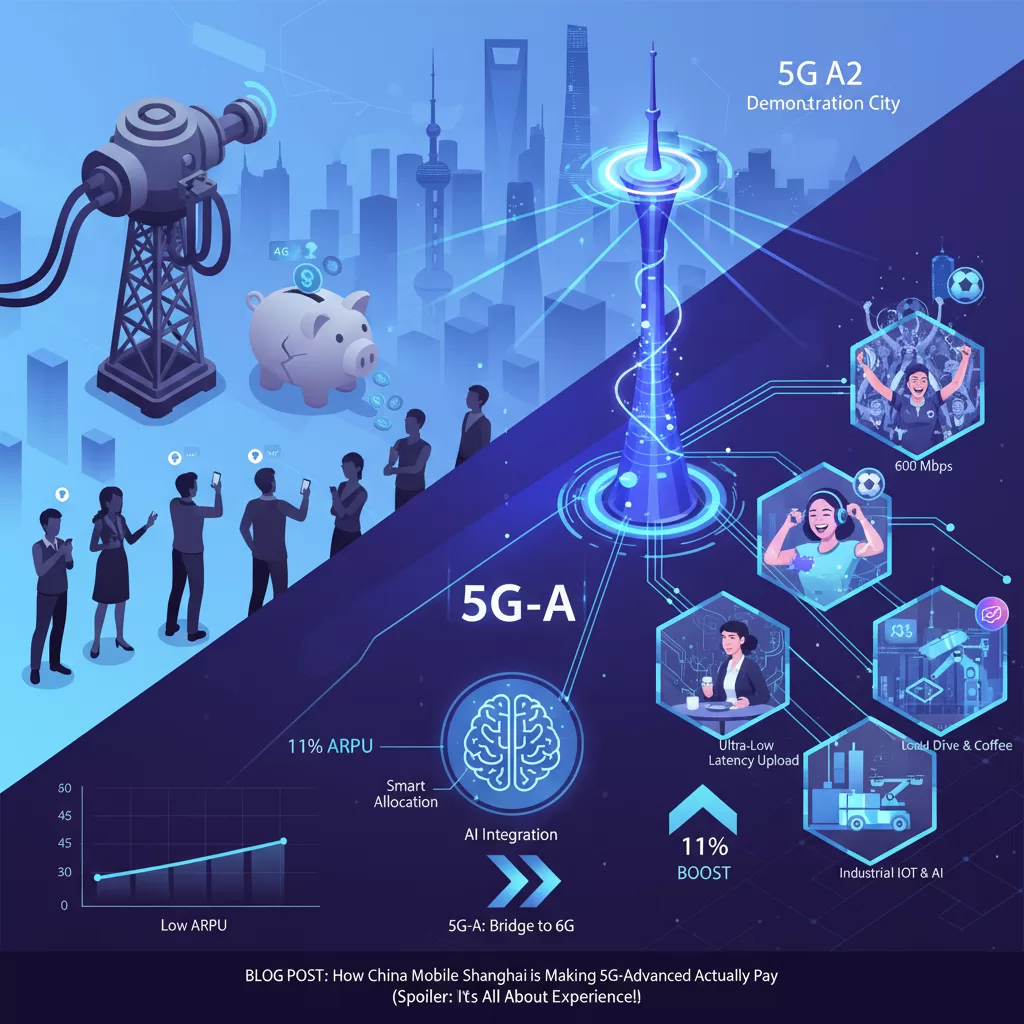
The Shenhua Football Fans VIP Pass is perhaps the most illustrative. Imagine being in a packed stadium, yet enjoying guaranteed speeds of 600 Mbps, allowing you to stream the match in pristine quality, access exclusive content, and even personalize your phone with unlimited video ringtones featuring your favorite players. It’s about creating a sense of exclusivity, of being part of an elite group.
But the innovation doesn’t stop there. China Mobile Shanghai has crafted packages tailored to various “life-scenarios,” from live streamers demanding unwavering upload speeds to hardcore gamers requiring ultra-low latency. They even offer a “5G-A Metro package” promising seamless connectivity during underground commutes. The Coffee Break Bonus, which combines 5G-A cloud drive packages with discounts at local coffee shops, cleverly integrates technology into the fabric of everyday life, targeting business professionals and young users.
And the results speak for themselves. Users subscribing to these 5G-A packages exhibit a 20% higher data usage and an impressive 11% increase in Average Revenue Per User (ARPU).
The focus extends beyond individual consumers. 5G-A is empowering enterprises across various sectors, offering customized network slicing for logistics companies, manufacturing plants, and smart campuses, guaranteeing specific performance levels tailored to their unique needs. Shanghai’s ambition to become a “5G A2 Demonstration City” further underscores this commitment, fostering an ecosystem for industry transformation driven by the fusion of “Advanced x AI”.
Underpinning these innovations is Huawei’s technological prowess. Their GainLeaptechnology intelligently identifies premium users, allocating dedicated, high-speed channels to ensure optimal performance. AI is woven throughout the network, with intelligent wireless boards leveraging machine learning to dynamically optimize performance based on real-time user activity. Huawei’s SmartCaresolution provides China Mobile with granular insights into user experience, enabling them to fine-tune service quality and target new subscribers with laser precision.
V. The Bumpy Road Ahead: Challenges and Lingering Doubts
While China Mobile Shanghai’s success is undeniable, the path to widespread 5G-A adoption is not without its obstacles.
The substantial upfront investment required to upgrade to 5G-A remains a significant hurdle. Can all carriers realistically justify these costs, particularly in markets where consumer willingness to pay for premium connectivity remains uncertain?
The slow adoption of 5G Standalone (SA) networks globally also poses a challenge. Many carriers are hesitant to make the transition due to the complexity and expense involved, yet full 5G SA is essential for unlocking the full potential of 5G-A’s advanced features.
And then there’s the fundamental question of value proposition. While China Mobile Shanghai is demonstrating the viability of “experience monetization,” will this model resonate universally? Or will a significant portion of consumers continue to perceive the benefits of 5G-A as incremental, not transformative?
The geopolitical landscape also casts a shadow, with Huawei’s central role in 5G-A development sparking concerns among some governments due to national security considerations.
Moreover, the proliferation of connected devices and increasingly complex networks magnifies cybersecurity and data privacy risks. And let’s not forget the persistent (though largely unfounded) health concerns surrounding 5G radiation, which continue to linger in the public consciousness. Finally, the increased power consumption associated with advanced connectivity remains a concern, potentially leading to faster battery drain on mobile devices.
VI. The Horizon: What’s Next for 5G-A and the Path to 6G
Despite these challenges, China Mobile Shanghai is forging ahead with ambitious expansion plans, aiming to extend 5G-A coverage across Shanghai and into hundreds of cities nationwide by the end of 2025.
Expect to see even more sophisticated network aggregation technologies, such as 3CC (combining different frequency bands), and deeper integration of AI, paving the way for “AI-native” networks. The company is also fostering an ecosystem of new 5G-A devices, including glasses-free 3D phones, and forging industry alliances to drive the development of 100 benchmark industry applications.
5G-A is increasingly viewed as a critical stepping stone towards a future where AI permeates every aspect of our lives, driving innovation and economic growth. Crucially, 5G-A is directly informing the development of 6G. Early research and standardization efforts are already underway, with 5G-A serving as a vital proving ground for future innovations.
VII. Conclusion: A Blueprint for the Connected Future?
China Mobile Shanghai and Huawei are not merely building a faster network; they are attempting to redefine how we value connectivity. By focusing on differentiated, scenario-based experiences, they are offering a compelling model for telecom operators seeking to thrive in increasingly competitive markets.
The journey is undoubtedly fraught with challenges, but the bold experimentation taking place in Shanghai provides a tantalizing glimpse into the future. It suggests that 5G-Advanced, when approached with creativity and a deep understanding of user needs, can indeed unlock its transformative potential, laying the foundation for an even more intelligent and interconnected world as we move towards the dawn of 6G.