
I. Introduction: The AI Wave Hits Asia Pacific
AI isn’t just a buzzword anymore; it’s a colossal, power-hungry beast, and Asia Pacific’s data centers are feeling the crunch (and the heat!). The quiet hum of servers is escalating into a desperate clamor as these facilities struggle to keep pace. The region is at the forefront of the AI revolution, a digital El Dorado promising untold riches. But this rapid adoption is pushing its digital infrastructure to its limits, straining its very foundations. We’re talking about a race against time, a frantic sprint to build, upgrade, and innovate. The stakes? Nothing less than Asia’s position as a global tech leader.
The big question looms: Can the region’s data centers transform fast enough to meet the insatiable demands of AI, or are we heading for a digital bottleneck? Are we destined to watch the engine of progress sputter and stall, choked by its own ambition?
II. A Quick Trip Down Memory Lane: How APAC’s Data Centers Grew Up
To understand the present predicament, we must first journey through the annals of APAC’s data center history. It’s a story of constant reinvention, each era building upon the last in a somewhat haphazard, yet ultimately progressive manner.
- From “Big Iron” to the Internet Age (Pre-1990s – Early 2000s):The saga begins with the “big iron,” those monolithic mainframes that occupied entire rooms within government agencies and banking institutions. These were custom-built behemoths, the digital equivalents of ancient empires. Then, the rise of microprocessors and the internet democratized computing, bringing servers into every office and spawning the first in-house data rooms. The dot-com bust, a harsh but valuable lesson, instilled a newfound appreciation for efficiency and scalability.
- The Cloud’s Reign and Hyperscale Dreams (Mid-2000s – Present): The advent of smartphones, e-commerce, and social media triggered an unprecedented explosion of data generation, ushering in the public cloud era. Tech giants like AWS, Google, and Alibaba emerged, constructing massive, hyperscale data centers in strategic hubs like Singapore, Tokyo, and Hong Kong. These were temples of data, vast and awe-inspiring in their scale.
- The Dawn of AI: Each stage, from the era of mainframes to the cloud revolution, laid the groundwork for today’s unprecedented AI-driven demands. But none could have truly predicted the voracious appetite of this new digital leviathan.
III. The AI Tsunami Hits: What’s Happening Right Now
Now, the AI tsunami crashes upon the shores of APAC’s data centers, threatening to overwhelm the infrastructure painstakingly built over decades.
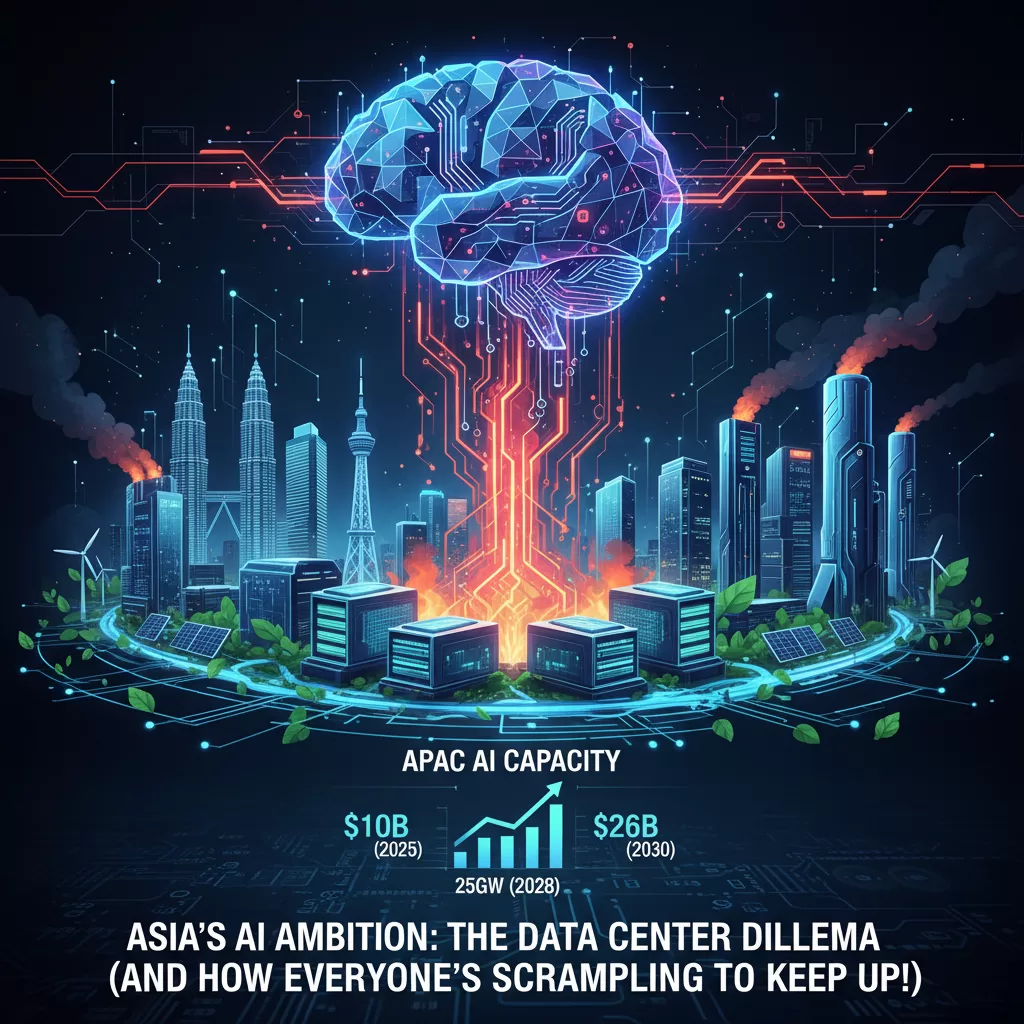
- Unprecedented Demand: AI, especially generative AI and machine learning, is guzzling computational power at an insane rate, a rate that defies historical precedent. The numbers tell the story: APAC’s AI-optimized data center market is projected to explode from nearly $10 billion in 2025 to over $26 billion by 2030. Overall capacity is expected to double in the next five years! These figures aren’t just statistics; they represent a fundamental shift in the demand for digital infrastructure.
- The Power and Heat Problem: AI workloads, particularly those driven by GPUs, demand significantly higher power densities – we’re talking about racks needing more than double traditional setups, potentially hitting 1 megawatt by 2030! Traditional air cooling? Forget about it. It’s akin to trying to cool a supernova with a household fan. The sheer intensity of the heat generated requires innovative solutions.
- “AI-Ready” or Bust: Many existing data centers simply weren’t designed for this level of intensity, leading to a looming shortfall estimated to be between 15 to 25 gigawatts by 2028. The harsh reality is that a significant portion of the existing infrastructure is simply unfit for the AI era.
IV. The Dark Side of the Boom: Controversies and Challenges
However, the AI boom casts a long shadow, raising critical questions about sustainability, resource allocation, and ethical considerations.
- The Green Dilemma: Power vs. Planet: AI’s insatiable hunger for electricity is straining power grids (many still reliant on fossil fuels), dramatically increasing carbon emissions. Consider this: one AI training session can consume as much energy as hundreds of homes in a year! Advanced cooling systems, especially liquid cooling, are highly water-intensive. A single hyperscale data center can use 1.5 million liters a day! With water scarcity already a pressing concern, the environmental implications are staggering. The big debate rages: how do we balance technological advancement and economic growth with environmental sustainability? Are “green” efforts being sidelined in the AI rush?
- Location, Location, What Location?: Developed hubs like Singapore and Tokyo are running out of land and power, forcing new developments to relocate to emerging markets such as Malaysia and Indonesia. This shift introduces new challenges, including unstable power grids, infrastructure gaps, and a scarcity of skilled talent.
- Regulatory Roadblocks:Governments are increasingly scrutinizing energy consumption and sustainability, leading to stricter regulations and even moratoriums on new data center construction (as seen in Singapore). These regulatory hurdles add complexity and uncertainty to the development process.
- The Eye-Watering Price Tag:Building these sophisticated “AI Factories” necessitates massive capital investment, demanding innovative financing solutions. Securing the necessary funding requires a delicate balance of public and private partnerships.
V. The Race to Innovate: Solutions on the Horizon (and Vertiv’s Play)
Despite these challenges, innovation is flourishing, with new technologies and strategies emerging to address the demands of the AI era.
- From “Server Farms” to “AI Factories”: The industry is evolving from traditional “server farms” to purpose-built data centers, designed from the ground up to handle the intense demands of AI workloads. These “AI Factories” represent a paradigm shift in data center design.
- Cooling Down the Beasts:Traditional air cooling is becoming obsolete; advanced liquid cooling (direct-to-chip, hybrid systems) is essential to manage the extreme heat generated by AI workloads. Vertiv is playing a crucial role in this area, pushing hybrid and liquid cooling solutions, offering specialized coolant distribution units.
- Smarter Power, Stronger Grids:Advanced power solutions such as DC power shelves, larger Uninterruptible Power Supply (UPS) systems, and Battery Energy Storage Systems (BESS) are critical for efficiency and grid resilience. Vertiv is enhancing rack power distribution, busway systems, and offering modular UPS/BESS solutions to support hybrid energy sources.
- Building for Agility: Modular and prefabricated data center systems allow for rapid, scalable deployment, particularly in regions with limited resources. Vertiv is rolling out AI-enhanced micro modular data centers (like the SmartAisle™ 3) that self-learn to optimize energy use and simplify deployment.
- Sustainability as the Blueprint:Integrating renewable energy sources (solar, microgrids) and using AI within data centers to optimize energy consumption are paramount. Vertiv envisions integrated planning across power, cooling, and IT management, with a strong emphasis on alternative energy sources.
VI. Peeking into the Future: What’s Next for APAC Data Centers
Looking ahead, the future of APAC’s data centers is one of continued growth, innovation, and increasing complexity.
- Continued Explosive Growth:APAC is on track to surpass the US in total data center capacity by 2030, with China poised to dominate the AI data center landscape.
- AI Optimizing AI: Expect AI to be increasingly used within data centers for predictive maintenance, resource allocation, and even smarter cooling, leading to “self-learning” facilities.
- Edge of Innovation: Edge computing will expand dramatically, bringing processing closer to the source of data for ultra-low latency applications (think 5G and IoT).
- Cybersecurity Fortresses: With increased complexity comes increased vulnerability; “cybersecurity by design” will become the standard, building resilience into the very foundations.
- New Hotspots Emerge: Keep an eye on emerging AI data center clusters in locations like Johor Bahru (Malaysia), Batam Island, Kyushu (Japan), and Busan (Korea) as demand shifts.
- The Sustainability Imperative Deepens: Expect more circular water solutions and even cautious exploration of small modular reactors (SMRs) for nuclear energy as the push for greener power intensifies.
VII. Conclusion: A Power-Packed Future, or a Power Problem?
The AI boom presents APAC’s data centers with both incredible opportunities and daunting challenges, ranging from managing raw power and heat to navigating environmental concerns.
The stakes are high. Success means powering a new era of innovation, unlocking unprecedented economic growth, and solidifying Asia’s position as a global technological leader. Failure, on the other hand, could lead to resource scarcity, environmental degradation, and a stifling of innovation.
The race is on for APAC’s data centers to evolve into intelligent, sustainable, and robust infrastructures capable of supporting the AI-driven future. It’s not simply about building more; it’s about building smarter, greener, and more resilient systems. The future of Asia’s AI ambition hinges on the decisions made today. Will the region rise to the challenge, or will it succumb to the weight of its own ambition? Only time will tell.