
Big News from Above!
Ever considered the ethereal whispers of your private conversations traversing the vast expanse above? Imagine a scenario straight out of a Cold War thriller: someone, armed with nothing more than a rudimentary antenna, casually eavesdropping on your most intimate phone calls or pilfering your private messages directly from the sky. Sounds like fanciful paranoia, doesn’t it?
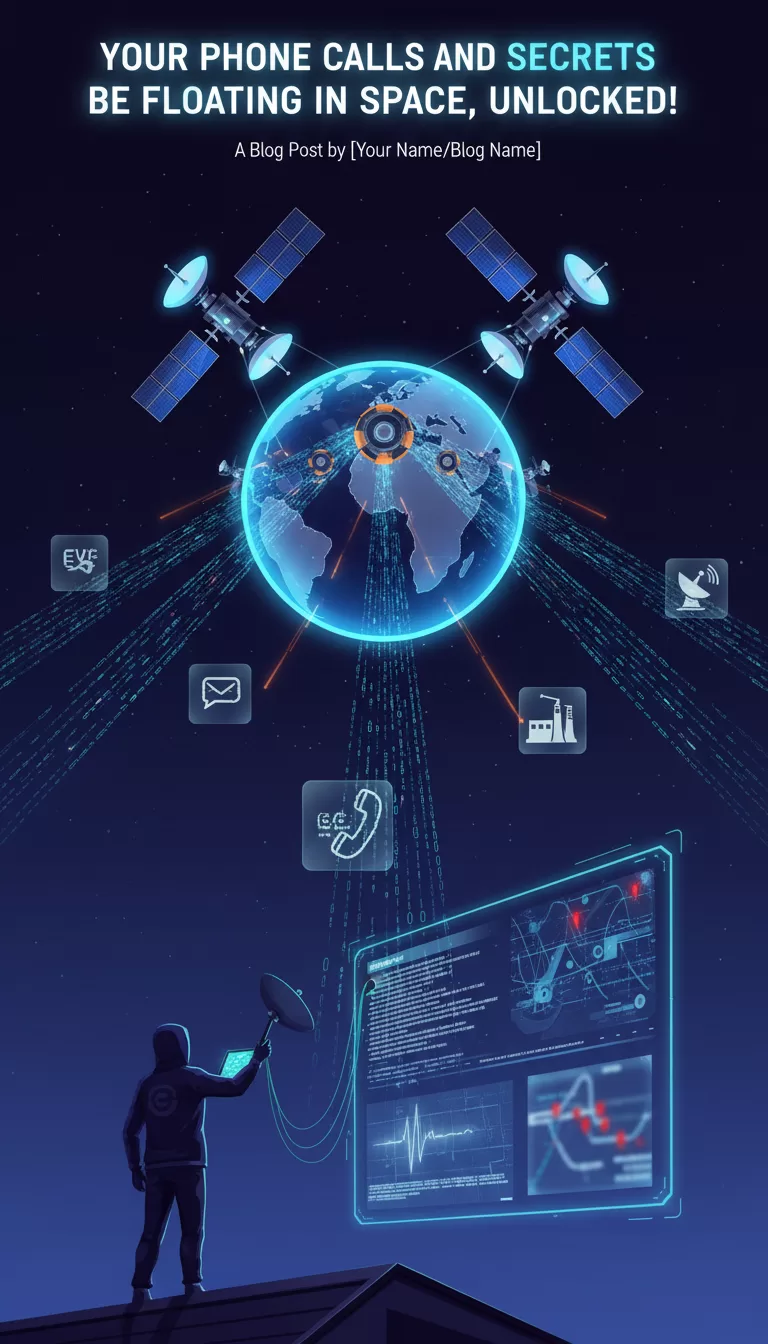
But what if I told you this isn’t science fiction? Recent investigations have unearthed a disturbing reality: a significant number of satellites are broadcasting sensitive data – think unfiltered phone calls, unencrypted text messages, and even, alarmingly, military communications – completely in the clear.
The implications are staggering. This isn’t just a theoretical vulnerability; it’s an open door. The ease with which this data can be intercepted poses a grave threat to individual privacy and national security alike.
What’s Happening Up There?
Satellites have become the unseen architects of modern life. From the mundane act of checking our smartphones to the intricate ballet of global internet connectivity and even the seemingly simple task of navigating with GPS, we are inextricably reliant on these celestial sentinels. These satellites relentlessly beam data back to Earth, creating a constant stream of information flowing above our heads.
The core of the problem lies in a fundamental miscalculation. Many organizations, both commercial and governmental, have operated under the assumption that actively monitoring satellite communications would be too technically challenging or economically unviable to be a significant threat. Consequently, they neglected the crucial step of encrypting their data, leaving it vulnerable to interception.
Consider this: a team of researchers, with a modest investment of around $800, assembled a relatively simple receiving system. With this inexpensive setup, they successfully intercepted unencrypted phone calls and text messages originating from T-Mobile networks. They also managed to capture sensitive data transmitted via airplane Wi-Fi systems, as well as revealingly unencrypted communications from power stations and even military units operating in the United States and Mexico. Imagine the potential consequences: hostile actors gaining access to troop movements or anticipating vulnerabilities in critical infrastructure.
A Blast from the Past: When Did This Start?
The idea of using satellites for espionage isn’t new. During the Cold War, both the United States and the Soviet Union pioneered satellite surveillance programs like Corona, a project that involved literally dropping exposed film canisters back to Earth for processing. The audacity of the endeavor is breathtaking in retrospect.
Even in the relatively recent past, during the 1990s and early 2000s, vulnerabilities in satellite systems were exploited. Ground-based computer systems controlling satellites were targeted, demonstrating the susceptibility of these orbital platforms to malicious actors.
The prevailing strategy for years was a form of “security by obscurity,” a tacit agreement to simply hope that no one would bother to look for these weaknesses. However, the proliferation of accessible technology and the increasing sophistication of potential adversaries have rendered this approach dangerously obsolete.
What Are People Saying Now?
Cybersecurity experts are sounding the alarm, labeling the lack of satellite data encryption a “high-priority threat.” The space industry, characterized by its rapid growth and innovation, has often prioritized functionality and speed over robust security measures.
A common sentiment is that many space-based companies have implicitly relied on “security by obscurity,” operating under the assumption that their vulnerabilities would remain undetected. The exponential increase in the number of active satellites only exacerbates the problem, creating more potential entry points for malicious actors.
Furthermore, the average citizen remains largely unaware of the extent to which commercial satellites monitor their daily lives. When confronted with the reality of constant, pervasive surveillance, even in the perceived privacy of their own homes, a strong sense of unease and resentment often emerges.
Why Is This Such a Mess?
The debate surrounding satellite surveillance raises complex ethical and legal questions. Governments assert the need to monitor communications to identify and neutralize potential threats, but where does one draw the line between national security and the fundamental right to privacy?
The availability of unencrypted satellite data also creates the potential for corporate espionage, allowing companies to gain an unfair competitive advantage by monitoring the communications and activities of their rivals.
The dual-use nature of satellite technology further complicates the issue. While satellites provide invaluable services such as weather forecasting and disaster monitoring, the same technology can be repurposed for tracking individuals without their knowledge or consent.
The absence of clear international regulations governing the use and protection of satellite data creates a legal vacuum, fostering a sense of lawlessness in the space domain.
Looking to the Stars: What Happens Next?
The future promises even greater reliance on satellite technology, with ambitious projects like global space-based internet constellations poised to connect every corner of the planet. This increased connectivity, however, will only amplify the risks if security vulnerabilities remain unaddressed.
One promising avenue lies in the application of Artificial Intelligence (AI) to detect and respond to cyberattacks in real-time, enabling faster and more effective threat mitigation.
Quantum encryption, a revolutionary cryptographic technique that leverages the principles of quantum mechanics, offers the potential to create virtually unbreakable codes.
The development of advanced antenna technologies that make signals more difficult to intercept represents another promising avenue for enhancing satellite security.
On a broader scale, governments and international organizations must collaborate to establish comprehensive legal frameworks governing the use and protection of satellite data.
Finally, security must be baked into the design of satellite systems from the outset, rather than being treated as an afterthought.
Collaboration between industry, government, and cybersecurity experts is essential to ensure the long-term security and integrity of our space-based infrastructure.
Conclusion: Time to Look Up
The recent revelations regarding the widespread lack of encryption in satellite communications serve as a stark wake-up call. Our personal and national secrets are demonstrably vulnerable.
It is incumbent upon each of us to become more aware of how our data is being used and to advocate for stronger privacy and security measures.
Despite the challenges, there is reason for optimism. By embracing new technologies, establishing clear legal frameworks, and fostering collaboration across sectors, we can ensure that our communications remain private and secure, even as they traverse the vast expanse of space. The time to act is now. The secrets we save may be our own.